
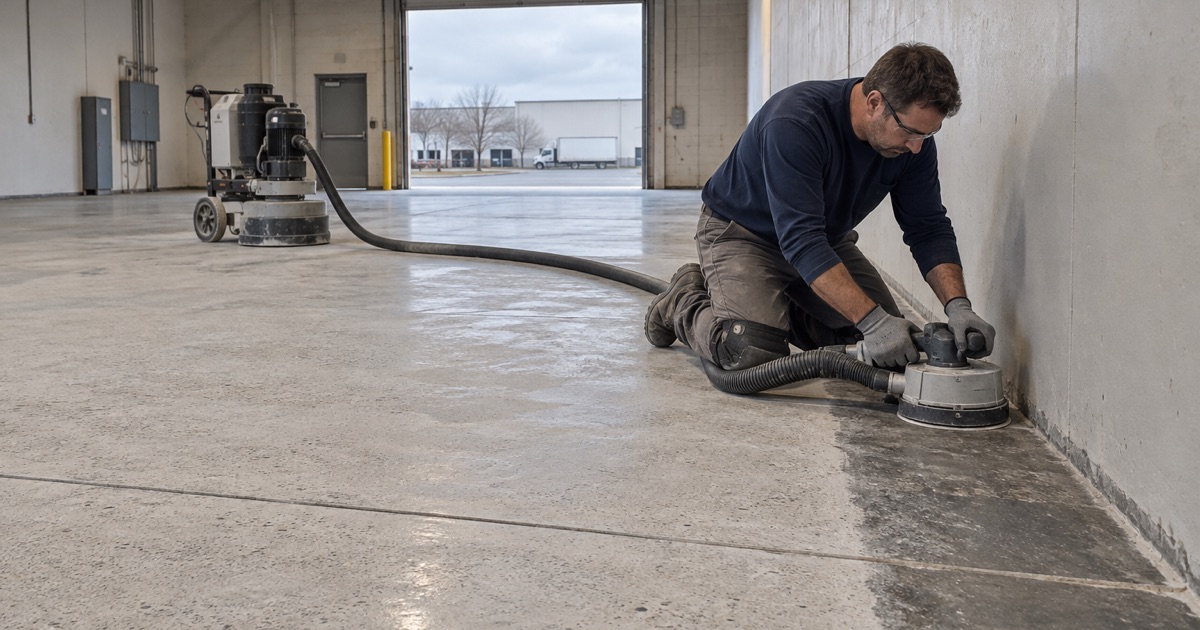
Tinley Park Epoxy Flooring provides concrete grinding in Tinley Park, IL, serving surrounding cities including Country Club Hills, Mokena, Matteson, Midlothian and Hazel Crest. After more than 20 years of preparing floors for coatings and polish, we know that surface preparation decides whether a floor lasts, so every slab we coat is opened with a diamond grinder or a shot blaster and never with an acid etch.
Grinding removes the weak, dusty top layer of concrete, along with old paint, sealers, adhesives and stains, and leaves an open surface that a primer can soak into. It also takes down high spots and ridges, which matters for metallic and self-leveling coats that show every bump.
We offer grinding as the first step of our own coating and polishing systems, and as a standalone service for owners and contractors who need a slab prepared for another product. Either way, the written scope names the target profile, the tooling and what is being removed.
Concrete Surface Profiles and Why They Matter
The ICRI CSP Scale
The International Concrete Repair Institute rates concrete surface profiles on a scale from CSP 1, nearly flat, to CSP 10, very rough. Each coating manufacturer names the profile its product needs, and thin coatings generally need a finer profile than thick, high-build systems.
We match the profile to the product named in the proposal, rather than grinding every floor the same way. Too smooth, and the primer has nothing to grip; too rough, and a thin coating will not cover the peaks, leaving them exposed to wear.
Checking the Profile Before Coating
After grinding, we compare the floor against profile reference chips and look closely at edges, corners and areas around drains and pits, where a grinder cannot always reach. Those spots are finished with hand grinders so the whole floor carries the same profile before the primer goes down.
Diamond Grinding Versus Shot Blasting
Diamond Grinding
A diamond grinder uses rotating heads fitted with metal or resin-bond diamond segments to cut the concrete surface. It handles old coatings, mastic and uneven areas well, and it is the main tool for garages, basements and most residential floors.
Grinding also flattens as it cuts, taking down trowel ridges and lips at control joints. That is why it is the usual choice under metallic epoxy, polished concrete and any finish where a flat surface shows.
Shot Blasting
A shot blaster throws small steel shot at the floor and vacuums it back up, leaving a uniform textured profile. It is fast on large, open commercial and industrial floors, and it suits high-build systems that want a rougher surface to bond to.
Shot blasting follows the floor rather than flattening it, so it is not the right choice where unevenness would show. We often combine the two methods on one job, shot blasting the open field and grinding the edges, joints and high spots.
What Grinding Removes
Old Coatings, Paint and Sealers
Peeling epoxy, porch paint, kit coatings and clear sealers are ground off completely before a new system is installed. A new coating bonded to an old layer can only be as strong as that old layer, so we do not coat over anything that is failing.
Store-bought garage kits are a common find. They are usually thin, water-based products rolled over an acid-etched slab, and once they start lifting under hot tires, the only reliable fix is to grind them away entirely and start again from sound concrete.
Tile Mastic, Carpet Glue and Patches
Basement floors often carry black mastic from old vinyl tile, carpet adhesive and patching compound. We remove these with tooling suited to soft, gummy materials, and we ask about the age of any tile adhesive because very old mastic can contain asbestos and should be tested first.
Contamination, Laitance and Efflorescence
Oil stains, weak laitance from the original finishing and the white powder of efflorescence all interfere with adhesion. Grinding removes the surface layer that holds them, although deep oil may need cleaning or extra passes, and efflorescence also tells us to look closely at moisture.
Dust Control and Job Site Care
Vacuums at the Machine
Every grinder and shot blaster we run is connected to a vacuum that captures dust at the point it is made. That protects the people in the building, keeps dust out of the house next to an attached garage, and leaves less cleanup at the end of the day.
In an attached garage, we also seal the door into the house and keep the overhead door managed for airflow. Concrete dust is fine enough to travel through small gaps, so we treat containment as part of the job rather than an afterthought at cleanup.
Keeping Slurry and Dust Out of Drains
We never rinse grinding dust or slurry toward a floor drain, a basement ejector or a storm inlet at the curb. Captured dust is bagged and disposed of, so the job does not send concrete fines into the sewer or the storm system.
Moisture Testing After Grinding
Grinding opens the surface, which is the right time to test for moisture. We run a plastic sheet test under ASTM D4263, a calcium chloride test under ASTM F1869 or relative humidity probes under ASTM F2170, and the result decides whether a moisture-mitigation primer is needed before any coating.
When Grinding Is Not Enough
Slabs That Need Repair First
Grinding exposes the real condition of a slab, including cracks, spalls and hollow-sounding areas hidden under old coatings. We map what we find and repair it before coating, and when a slab has heaved, settled or broken apart, we say so and recommend repair or replacement rather than coating a floor that will keep moving.
Those findings are added to the written scope with a price for each repair. You see what grinding uncovered and what it will cost to fix before any coating is ordered, rather than learning about it from a change order halfway through the job.
Weather and Cure Conditions
Grinding can happen in almost any season, but the coating that follows needs the right slab temperature and dew point spread. In an unheated garage in deep winter, we may grind and repair now and recommend waiting for warmer weather to coat, rather than rushing a floor that will not cure properly.
If grinding and coating are split across seasons, we protect the prepared slab and give it a light re-grind and cleaning before the coating goes down. Dust, oil drips and salt residue that settle on an open profile over a winter would otherwise weaken the bond we worked to create.
- 20+ Years Coating Floors
- Moisture Test in Every Scope
- Free Written Estimates