
Tinley Park Epoxy Flooring installs industrial epoxy flooring in Tinley Park, IL, serving surrounding cities including Country Club Hills, Mokena, Matteson, Midlothian and Hazel Crest. Over more than 20 years of floor work, we have learned that industrial floors fail at predictable places: forklift turns, joint edges, dock plates and anywhere chemicals sit. We design the system around those points rather than the brochure.
The south suburbs carry a solid base of warehousing, distribution and light manufacturing, with slabs that take heavy wheel loads every shift. A floor in that setting has to be specified by traffic, chemicals and temperature, and then installed without stopping the operation for longer than it can afford.
Every proposal we write names the product line, the number of coats, the finished thickness and the phasing plan. It also records the moisture test result and the joint and crack repairs, so a plant manager can check the floor against the scope after the crew leaves.
Industrial Floor Systems and Where They Fit
High-Build 100% Solids Epoxy
A 100% solids epoxy builds real thickness in each coat and bonds strongly to a ground or shot-blasted slab. In high-build form it handles pallet jacks, carts and moderate forklift traffic, and it is the workhorse system for warehouses, storage areas and assembly floors.
Thickness is the variable that separates a floor that lasts from one that wears through in the first year. We state it in the proposal for each zone, so the high-traffic lanes get the build they need and quieter storage areas are not over-specified.
Troweled and Slurry Systems
Where traffic is heavy or impact is common, a troweled epoxy mortar or a slurry broadcast system adds thickness and toughness. These systems resist gouging from dropped parts and the grinding action of forklift wheels at turns and dock doors.
Urethane Cement for Heat and Chemicals
Food processing, wash-down areas and spaces with hot water or strong chemicals need more than standard epoxy. Urethane cement tolerates thermal shock and aggressive cleaning, and it is often the right choice where an epoxy would soften or crack.
Topcoats for Abrasion and Chemicals
Polyurethane and polyaspartic topcoats add abrasion and chemical resistance over an epoxy base. A quartz aggregate broadcast under the topcoat adds grip in wet or oily areas, and the level of texture is written into the specification rather than left to chance.
Forklift Traffic, Joints and Loading Docks
Forklift and Pallet Jack Wheel Loads
Hard polyurethane and nylon forklift wheels carry heavy loads on a small contact patch, and they grind coatings at turns and stopping points. We identify those traffic lanes in the walk-through and specify a thicker system there, so the floor matches the equipment rather than the lowest bid.
Joint Repair and Armoring
Control and construction joints are where industrial floors break down first. We clean out failed fillers, rebuild spalled edges with high-strength epoxy or polyurea, and refill the joints before coating, so wheels roll across a solid edge instead of chipping it further.
Dock Areas and Transitions
Loading docks take truck traffic, winter brine and constant impact at the dock plate. We reinforce those areas with heavier systems and make clean transitions between coated and uncoated zones, so edges do not lift where equipment crosses them.
Dock areas also see the most winter brine, carried in on truck tires and pallet loads. A chemical-resistant topcoat and a textured finish keep that meltwater from soaking into the slab and keep the floor safe to walk on during the wettest months.
Preparation and Moisture Testing
Shot Blasting and Diamond Grinding
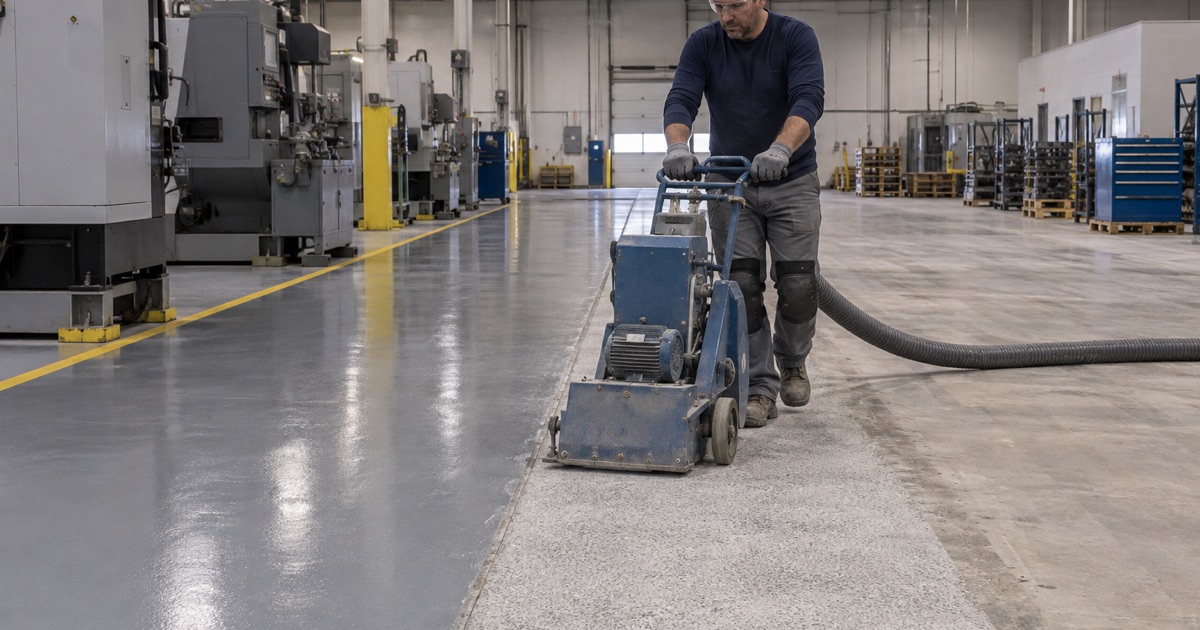
Large industrial floors are usually shot blasted across the open field and diamond ground at edges, joints and high spots. Both methods leave a measured ICRI concrete surface profile, and both run with vacuums attached so dust is captured at the machine rather than spread through the building.
Removing Old Coatings and Contamination
Old coatings, oil-soaked concrete and curing compounds all weaken adhesion. We remove failing coatings completely and clean or grind out oil contamination, noting in the scope where heavily soaked areas may need extra work.
We never rinse grinding dust, shot blast residue or degreasing water toward a floor drain or storm inlet. Captured material is bagged and removed, which keeps the facility clear of trouble with the sewer district and keeps the drains working.
Moisture Testing Industrial Slabs
Slabs on grade can carry moisture from below, especially where the original vapor retarder is missing or damaged. We test with calcium chloride kits under ASTM F1869 or relative humidity probes under ASTM F2170 and add a moisture-mitigation primer where the readings call for one.
Safety, Compliance and Scheduling
Egress Striping and Floor Markings
The Tinley Park building code amends IBC 1014.2 to require that an egress path through an intervening space have a 44-inch aisle, striped in a contrasting color for its full length. We build that striping and any other aisle, walkway or hazard markings into the coating system, so they last as long as the floor.
VOC Rules and Product Selection
The Chicago area is in the 2015 ozone nonattainment area, and 35 Ill. Adm. Code Part 223 limits VOC content in industrial maintenance and floor coatings. Those limits bind the applicator, so we choose compliant products and keep the documentation with the job file.
Phasing Around Production
Industrial floors are coated in zones, scheduled around shifts, weekends and planned shutdowns. We plan cure times so each zone returns to service when production needs it, and the plan is agreed in writing before we start.
Cure conditions matter in large, partly heated buildings. We check slab temperature and the dew point spread at the surface before each coat, because condensation on a cold warehouse slab causes amine blush and a weak bond between layers.
Licensing, Bonds and Warranty Terms
Illinois has no state flooring license, so we check each village’s contractor license, bond and insurance requirements before booking. We also explain warranty exclusions before the contract is signed, including moisture from below, chemical exposure beyond a product’s rating and impact damage.
- 20+ Years Coating Floors
- Moisture Test in Every Scope
- Free Written Estimates