Tinley Park Epoxy Flooring installs polyaspartic floor coating systems in Tinley Park, IL, serving surrounding cities including Country Club Hills, Mokena, Matteson, Midlothian and Hazel Crest. After more than 20 years of coating concrete, we use polyaspartic where its fast cure, color stability and abrasion resistance make a real difference, and we say so when a different system would serve the floor better.
Polyaspartic is a fast-reacting coating chemistry related to polyurea. It can be used as a full system on its own, but most often it is the topcoat over a ground slab and a 100% solids epoxy base, where it takes the abrasion, chemicals and sunlight that a floor sees every day.
Because polyaspartic cures quickly, the working window is short and the prep has to be right the first time. Every slab is diamond ground or shot blasted, tested for moisture and repaired before any product is mixed, and our proposal names the product line, the number of coats and the finished thickness.
What Makes Polyaspartic Different
Fast Cure and Short Downtime
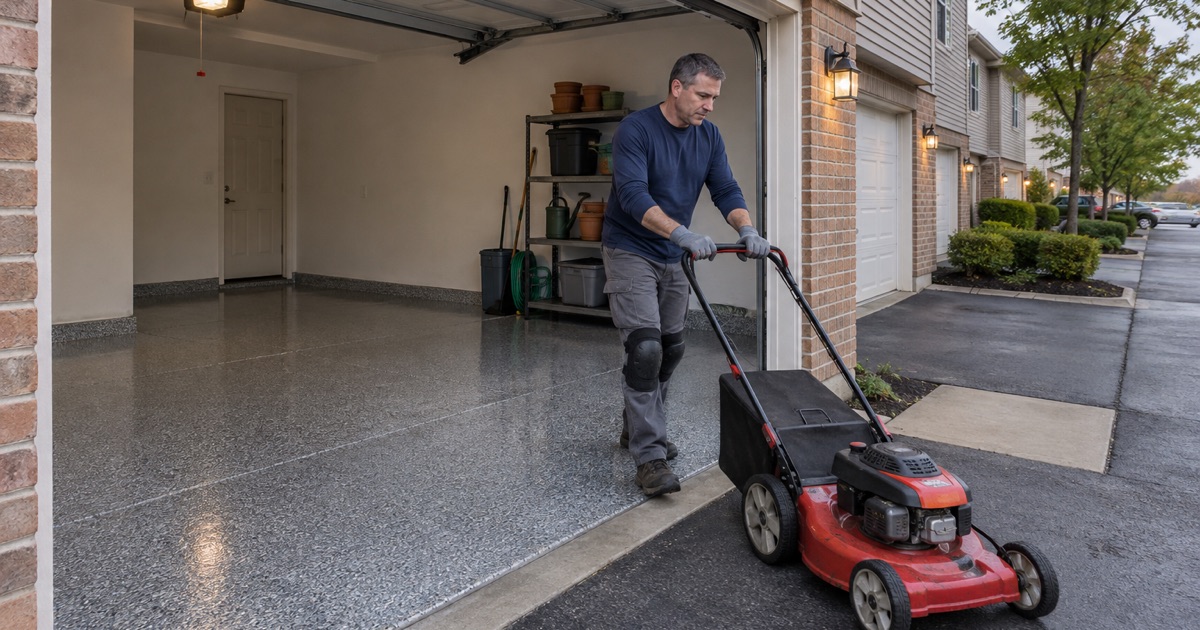
Polyaspartic coatings react and harden far faster than most epoxies, often allowing foot traffic within hours and vehicle traffic much sooner than an all-epoxy floor. That speed is why many garages can be finished in a single working day.
The tradeoff is a short pot life, which means the product has to be mixed in small batches and spread by an experienced crew. Rushed or overextended batches leave roller marks and thin spots, so we plan the floor in sections that match the product’s working time.
UV Stability and Color Retention
Standard epoxy can amber when sunlight reaches it through an open garage door or a showroom window. An aliphatic polyaspartic topcoat holds its color under ultraviolet light, which keeps flake blends and solid colors looking the way they did on installation day.
That matters most on floors that face the street or a bank of windows. A garage left open on summer afternoons, or a showroom with glass along one wall, will show the difference between an epoxy topcoat and a UV-stable one within a season or two, often as a tan cast along the brightest edge.
Abrasion, Chemical and Hot Tire Resistance
A hard polyaspartic topcoat resists the scuffing of tires, dropped tools and furniture, and it stands up to motor oil, antifreeze and road brine better than many single-coat systems. Over a full-build base, it also resists hot tire pickup, where a warm tire softens a thin coating and lifts it off the slab.
Resistance still depends on thickness and bond. A thin polyaspartic coat rolled over an acid-etched slab can fail just like a cheap kit, which is why we never treat the product name as the specification and always list the coats and finished thickness in the proposal.
Polyaspartic in Local Garages
Coating Through the Shoulder Seasons
Polyaspartic cures at lower temperatures than most epoxies, which stretches the season for coating a garage into late fall and early spring. We still measure slab temperature and the dew point spread at the surface before mixing, because condensation on a cold slab ruins any coating.
An attached garage that holds temperature can often be done in winter. An unheated detached garage during a hard freeze is scheduled for a warmer stretch, whatever the product’s label says about cold curing.
Brine, Rock Salt and Meltwater
Calcium chloride brine and rock salt arrive on tires all winter and sit on the floor as meltwater. A chemical-resistant polyaspartic topcoat keeps that brine on the surface where it can be squeegeed out, so the concrete underneath does not soak up chloride and flake.
We build enough film to protect the edges and the apron at the door, where tires drop the most meltwater, and we leave the slab’s pitch toward the door or drain intact so water keeps running off. A floor that holds puddles in the middle will stain and dull there first.
Moisture Under Garage Slabs
The village garage specification calls for concrete over stone with no vapor retarder named underneath, so ground moisture can rise through many garage slabs. We run a moisture test on every garage, and a high reading means a moisture-mitigation primer goes under the polyaspartic system rather than gambling on the result.
For a quick screen we tape down a plastic sheet under ASTM D4263, and for a measured reading we use a calcium chloride test under ASTM F1869. The test and its result go into the written scope before the price is final, so the moisture decision is on paper rather than in someone’s memory.
Attached Garages and Odor
Most local homes with a garage have an attached one, which shares a door with the kitchen, mudroom or laundry. Polyaspartic carries a noticeable odor while it cures, so we seal the house door, ventilate the garage, and capture grinding dust at the machine with a vacuum so it does not drift indoors.
Commercial Polyaspartic Floor Coating
Dealership Service Bays and Showrooms
Auto dealers and service shops need floors that come back into use quickly and stand up to hot tires, fluids and winter brine. Polyaspartic topcoats suit those spaces, and a fast cure lets us coat a bay overnight or over a weekend instead of closing it for days.
We build those floors with a texture that stays safe when wet, because a smooth topcoat under dripping cars and snowmelt is a slip hazard for technicians. Where the space needs marked aisles, contrasting-color striping can be laid into the system so it lasts as long as the floor.
Retail, Clinic and Gym Floors
Retail stores, clinics and gyms use polyaspartic topcoats where a floor has to look clean, resist scuffing and return to service fast. We phase the work by section around opening hours and specify texture by the broadcast and topcoat chosen, not by a promise.
The short cure is what makes overnight and weekend schedules practical. A section ground and coated after closing can be back in use the next morning, which lets a business keep its doors open while the floor is redone in stages.
VOC Rules for Commercial Coatings
The Chicago area sits in the 2015 ozone nonattainment area, and 35 Ill. Adm. Code Part 223 sets VOC limits for floor and industrial maintenance coatings. Those limits apply to the applicator as well as the seller, so we choose compliant polyaspartic products and keep the paperwork with the job file.
Building a Polyaspartic Floor System
Grinding to the Right Profile
A fast-curing coating has little time to soak into the concrete, so surface preparation carries more of the bond. We grind or shot blast the slab to a measured ICRI concrete surface profile, which gives the primer an open, clean surface to grip.
Old paint, kit coatings and sealers are removed in this step, and cracks and spalls are filled and ground flush. When a slab has moving cracks or broken sections, we explain that a coating will not hold it together and recommend repair first.
Base Coats, Flake and Topcoats
Most systems pair a 100% solids epoxy or polyaspartic base with a vinyl flake or quartz broadcast and a clear polyaspartic topcoat. The base builds thickness, the broadcast adds texture and hides small flaws, and the topcoat takes the daily wear.
We can also install a solid color polyaspartic floor without broadcast for spaces that need a smooth, bright finish. Where grip matters, a texture additive in the topcoat is written into the scope.
Warranty Terms and What They Exclude
Polyaspartic systems carry manufacturer and installer warranties, but most exclude moisture vapor from below, impact damage and cracks that move after installation. We go through those exclusions before the job is sold, starting with moisture, so the coverage you expect is the coverage you get.
On home jobs over the state threshold, the warranty terms sit inside a written contract, and you receive the Illinois Home Repair: Know Your Consumer Rights pamphlet before any grinding starts. Both are part of the Home Repair and Remodeling Act, and both are handled before we start rather than at the final invoice.
- 20+ Years Coating Floors
- Moisture Test in Every Scope
- Free Written Estimates