
Tinley Park Epoxy Flooring installs flake epoxy floor systems in Tinley Park, IL, serving surrounding cities including Country Club Hills, Mokena, Matteson, Midlothian and Hazel Crest. In more than 20 years of coating garages, basements and commercial spaces, we have found that flake floors are the most forgiving finish for real-world use, because the broadcast hides small flaws and adds grip underfoot.
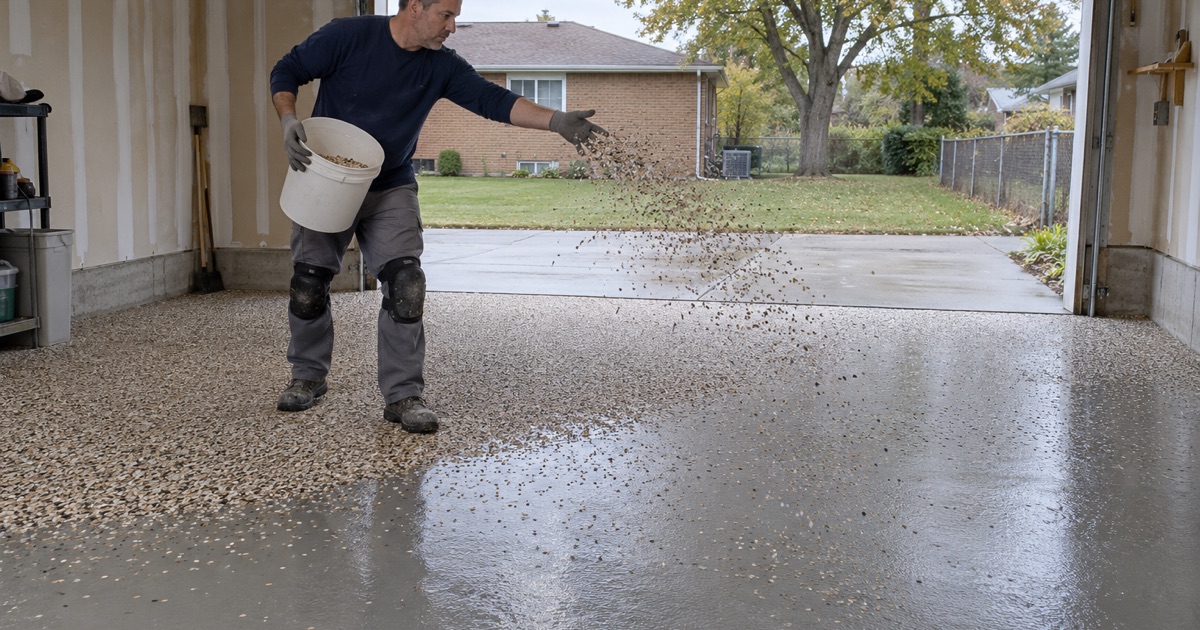
A flake floor starts with a ground, repaired slab and a pigmented base coat. Vinyl chips are broadcast into the wet base, the excess is removed once it sets, and a clear topcoat seals everything into one surface that is easy to clean and tough enough for daily traffic.
Our proposal names the base coat product, the flake blend and chip size, the broadcast coverage, the topcoat and the finished thickness. That way the floor you get can be checked against what was quoted, chip for chip.
Flake Blends, Chip Sizes and Coverage
Choosing a Flake Blend
Flake blends mix several colors of vinyl chip, from neutral grays and tans to bolder blends with black, white and accent colors. A blend that echoes the house trim, cabinets or business colors gives a finished look, while neutral blends hide dirt and tire marks best.
We bring physical samples and lay them on your floor rather than relying on a photo. Lighting in a garage or basement changes how a blend reads, and a sample in place shows that before the floor is committed.
Chip Size and Pattern
Larger chips create a bold, varied pattern that reads from across the room, while smaller chips create a tighter, granite-like texture. Some blends combine sizes for depth, and the choice affects how much of each slab flaw is hidden.
Chip size also changes how the floor feels to clean. Larger chips leave a slightly more pronounced texture under the topcoat, which helps grip but holds a little more grit, while smaller chips give a smoother surface that a squeegee clears in fewer passes.
Full Versus Partial Broadcast
A full broadcast covers the base coat until no color shows through, giving the most texture and the best coverage of patched or stained concrete. A partial broadcast scatters chips across a visible base color, which looks lighter and costs less in material but hides less.
For garages that see tires, salt and dropped tools, we usually recommend a full broadcast. Partial broadcast suits basements, utility rooms and spaces where a lighter look matters more than maximum durability.
Building a Durable Flake Floor
Grinding and Repairing the Slab
Every flake floor begins with diamond grinding or shot blasting to a measured surface profile, never an acid etch. Cracks, spalls and old coatings are mapped and repaired first, and when a slab has heaved or broken into sections, we say so rather than covering the problem with chips.
Grinding dust is pulled into a vacuum at the machine instead of being swept out the door or rinsed toward a drain. That keeps the work area clean for the base coat and keeps fine dust out of the house next to an attached garage.
Base Coats and Moisture
The base coat is usually a 100% solids epoxy or a polyaspartic, tinted to complement the flake blend. Before it goes down, we test the slab for moisture with a plastic sheet test or calcium chloride kit, and a high reading means a moisture-mitigation primer goes into the system first.
Local garage slabs are usually poured over stone with no vapor retarder underneath, which the residential code allows for garages. That is why we test every garage before choosing the base, rather than assuming a garage floor is dry because it looks dry.
Clear Topcoats and Texture
After the excess chips are scraped and vacuumed away, a clear polyaspartic or polyurea topcoat seals the floor. It protects the chips from abrasion and sunlight, resists hot tire pickup and chemicals, and can carry a texture additive where the floor gets wet.
The thickness of the topcoat changes how the floor feels underfoot. A thinner topcoat leaves more texture from the chips, while a thicker one gives a smoother, glassier finish, and we set that balance in the scope.
Flake Floors in Garages and Basements
Garages Through Winter
Flake floors are the most common choice for local garages because they handle calcium chloride brine, rock salt and meltwater well. The busy pattern hides the white film brine leaves behind between cleanings, and the topcoat keeps salt from soaking into the concrete.
We schedule garage coatings around slab temperature and dew point, not the calendar. An attached garage that holds its temperature can often be coated in winter, while an unheated detached garage in a hard freeze waits for a warmer stretch.
Basements, Laundry Rooms and Workshops
In basements and split-level lower floors, a flake system hides old patch lines and minor slab marks while giving the space a finished look. We coat around sump pits, ejector pits and floor drains, keep their covers removable, and make clear that a coating is not waterproofing or radon mitigation.
Laundry areas get extra texture in the topcoat where floors get wet, and workshops get a thicker build to handle dropped tools and rolling carts. Home jobs over the state threshold come with a written contract and the Illinois consumer-rights pamphlet before any grinding starts.
Commercial Flake Floors
Shops, Showrooms and Back Rooms
Flake floors also suit auto shops, retail back rooms, locker rooms and break areas, where they hide wear and add grip. We phase commercial work around opening hours, with overnight and weekend windows when a space cannot close.
In commercial spaces, flake is often paired with a quartz broadcast in wet zones or a solid color in storage areas. Matching the system to each area keeps the floor practical without paying for maximum build where it is not needed.
Warranty and Care
A flake floor cleans with a squeegee, a dust mop and a pH-neutral cleaner. Before the job is sold, we explain what the coating warranty excludes, starting with moisture from below, so the coverage is clear from the start.
- 20+ Years Coating Floors
- Moisture Test in Every Scope
- Free Written Estimates